
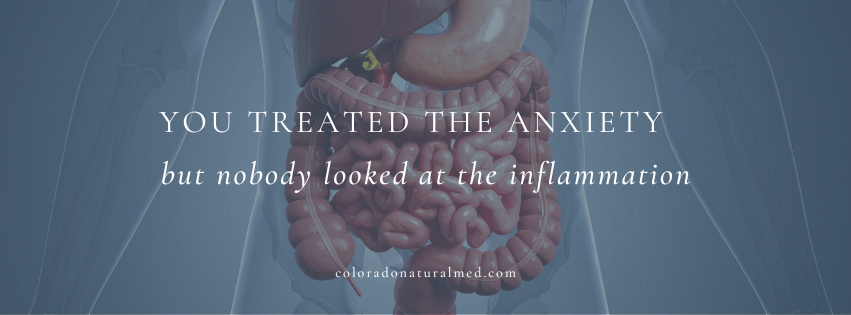
Why anxiety, depression, and mood symptoms that do not fully respond to therapy or medication may have a physiological driver most providers never evaluate.
When anxiety, depression, and chronic mood dysregulation do not fully respond to therapy or medication, the missing piece is often physiological rather than psychological. The gut and brain communicate constantly through the nervous system, immune system, inflammatory signaling pathways, and the gut microbiome. When gut health is compromised through dysbiosis, intestinal permeability, chronic inflammation, or nutritional deficiency, brain chemistry is directly affected. In many patients, mental health symptoms improve significantly only when the physiology driving those symptoms is addressed alongside conventional care.
She had done everything right.
Three years of therapy.
Medication.
Real work. Real effort.
And she was better in some ways. More self-aware. Better able to recognize her anxiety patterns when they surfaced.
But she still woke up anxious for reasons she could not explain.
There was a persistent low-grade tension underneath ordinary life. Brain fog that seemed disconnected from circumstance. Mood shifts that arrived without warning and without obvious triggers.
She was functioning.
But not well.
What nobody had asked about – not her therapist, not her prescribing physician – was her gut.
The bloating that had been present for years.
The inconsistent digestion.
The expanding food sensitivities.
The fact that her anxiety predictably worsened when her digestion was off.
She assumed these were separate problems.
They were not.
Because mental health is not always just a brain conversation.
Sometimes the physiology underneath it has never been examined.
The Problem With Treating Brain Chemistry in Isolation
Standard mental health care focuses primarily on the brain.
Therapy addresses thought patterns, trauma processing, behavioral change, emotional awareness, and relational dynamics.
Psychiatric medications work by altering neurotransmitter signaling pathways in the brain.
Both are valuable.
But both approaches often assume the problem exists entirely within the nervous system itself.
What frequently gets missed is a more important question: what is disrupting healthy brain function in the first place?
Because neurotransmitters do not exist in isolation. They are built from nutrients absorbed through the digestive system. They are influenced by inflammation levels regulated heavily through the gut. They are affected by immune signaling, cortisol output, blood sugar regulation, and microbiome health.
Mental health treatment often focuses on managing brain chemistry without investigating what may be impairing brain chemistry upstream.
That gap matters. And for patients who improve partially but never fully, it often explains why.
What the Gut-Brain Axis Actually Is
The gut-brain axis is a direct communication network linking the gastrointestinal system and the central nervous system.
The vagus nerve carries signals directly between the digestive tract and the brain. The enteric nervous system – often called the second brain – contains an enormous network of neurons embedded throughout the digestive tract that operate semi-independently from the brain itself. The gut microbiome regulates immune signaling, influences hormone production, affects inflammatory pathways, and directly shapes nervous system function.
The gut is not simply where digestion happens.
It is one of the body’s largest neurochemical and immune signaling centers.
And when dysfunction develops there, the brain feels the consequences.
The Inflammation Nobody Connects to Mental Health
One of the most overlooked drivers of mood symptoms is chronic systemic inflammation.
A healthy intestinal lining functions as a barrier – allowing nutrients to pass through while preventing inflammatory compounds, bacterial byproducts, and undigested food particles from entering circulation. When that barrier becomes compromised, a condition often referred to as intestinal permeability, inflammatory compounds escape into systemic circulation and activate the immune system.
The immune system responds by releasing inflammatory cytokines. Those inflammatory signals circulate throughout the body, cross the blood-brain barrier, and directly influence brain function.
The result often looks like anxiety. Depression. Low motivation. Cognitive slowing. Brain fog. Emotional volatility.
Research increasingly shows elevated inflammatory markers in patients experiencing depression and anxiety disorders. This matters because the intervention changes. You are no longer simply treating mood symptoms. You are identifying physiological stressors making those symptoms harder to resolve.
Why Gut Dysfunction Changes Mood
The digestive system plays a central role in producing and regulating the compounds the brain depends on to function normally.
The gut microbiome influences serotonin production. Certain bacterial species help regulate GABA – the neurotransmitter most directly involved in calmness and anxiety regulation. The microbiome affects dopamine signaling and regulates inflammatory compounds that directly affect mood, cognition, and resilience.
Research now shows that altering the microbiome directly changes stress behavior, inflammatory signaling, and emotional regulation.
The organisms living inside the digestive tract actively influence how the brain functions.
This is not theory. This is measurable physiology.
The Stress-Gut-Mood Cycle
One reason these symptoms become so persistent is because the relationship works in both directions.
Chronic stress directly damages gut health. Elevated cortisol alters gut motility, disrupts microbiome diversity, weakens the intestinal barrier, and increases inflammatory signaling. That inflammation then affects mood. Mood dysregulation activates the stress response. The stress response further damages the gut.
This is why many patients notice that their digestion worsens when anxiety increases – and their anxiety worsens when digestion is off.
This is not coincidence. It is physiology moving in both directions at the same time.
What Conventional Mental Health Treatment Often Misses
Therapy and medication are not being criticized here. They help many people significantly.
But there is an important limitation.
Therapy does not assess gut dysbiosis. It does not evaluate inflammatory markers. It does not identify nutritional deficiencies impairing neurotransmitter production.
Medication changes neurotransmitter signaling. It does not address the inflammatory environment degrading those neurotransmitters in the first place.
For patients who respond fully to conventional treatment, this distinction may not matter.
For patients who have done significant work and still feel persistently anxious, emotionally flat, cognitively foggy, or unable to fully stabilize – it matters enormously.
Because the problem may not exist entirely in the brain.
What Naturopathic Medicine Looks For
A naturopathic evaluation looks at the physiology affecting mental health rather than treating symptoms in isolation.
Gut health assessment identifies dysbiosis, intestinal permeability, digestive dysfunction, microbiome disruption, and inflammatory burden.
Functional testing identifies nutritional deficiencies directly involved in neurotransmitter production – magnesium, zinc, vitamin B6, folate, iron, omega-3 fatty acids, and vitamin D all directly affect mood regulation and nervous system function.
Inflammatory markers help determine whether systemic inflammation is contributing to anxiety, depression, or cognitive symptoms.
HPA axis testing evaluates whether chronic stress physiology is perpetuating both gut dysfunction and mood instability simultaneously.
Treatment depends entirely on what the physiology reveals. That may include dietary intervention to reduce inflammatory burden, targeted microbiome support, nutritional replenishment, gut repair protocols, acupuncture to regulate nervous system activity, and coordination with existing mental health providers when medication or therapy remains part of care.
The goal is not replacing mental health care.
The goal is addressing physiological variables mental health care was never designed to evaluate.
When Something Still Feels Missing
If you are currently in therapy, taking medication, doing the work – and still feel like something fundamental has not improved – pay attention to that.
That observation matters.
It may not mean the treatment is wrong. It may simply mean part of the picture has never been investigated.
At Colorado Natural Medicine & Acupuncture in Castle Rock, Dr. Adam Graves works with patients navigating anxiety, depression, mood instability, chronic stress physiology, gut dysfunction, inflammation, and the physiological patterns conventional mental health care often overlooks. Serving Castle Rock, Highlands Ranch, Parker, Monument, Larkspur, Sedalia, and the greater Douglas County area.
We offer a free 15-minute phone consult for new patients. If you feel like you have done everything right and still do not feel well – there may be more of the story left to uncover.
Frequently Asked Questions – Gut Health & Mental Health
Can gut health affect anxiety and depression?
Yes – significantly. The gut produces the majority of the body’s serotonin, houses the enteric nervous system, and regulates systemic inflammation through the gut barrier. When gut health is compromised through dysbiosis, intestinal permeability, or chronic inflammation, inflammatory signals travel to the brain and directly affect mood, cognition, and stress reactivity. Many patients experience meaningful improvement in mental health symptoms when gut health is addressed alongside conventional care.
What is the gut-brain axis?
The gut-brain axis is the bidirectional communication network between the gastrointestinal system and the central nervous system, operating through the vagus nerve, the enteric nervous system, the immune system, and the endocrine system simultaneously. Signals travel in both directions – the brain influences gut function through the stress response, and the gut influences brain function through neurotransmitter production, inflammatory signaling, and vagal nerve communication.
Why doesn’t therapy or medication fully resolve my anxiety or depression?
Therapy and medication address thought patterns and neurotransmitter signaling – but they do not assess or treat gut dysbiosis, intestinal permeability, nutritional deficiencies, or systemic inflammation that may be impairing neurotransmitter production and maintaining the neuroinflammatory environment that makes symptoms harder to resolve. For patients who respond partially but not fully to conventional mental health treatment, these physiological factors are frequently the missing piece.
What nutritional deficiencies affect mental health?
Magnesium, zinc, B6, folate, and iron are all required for serotonin and dopamine synthesis. Omega-3 fatty acids reduce neuroinflammation. Vitamin D influences mood regulation and immune function. These deficiencies are common in people experiencing mental health symptoms, frequently depleted by chronic stress or poor absorption due to gut dysfunction, and identifiable through functional testing.
What gut issues are most connected to mental health symptoms?
Gut dysbiosis directly affects serotonin production, GABA synthesis, and inflammatory signaling. Intestinal permeability allows inflammatory compounds into systemic circulation where they can cross the blood-brain barrier and affect brain function. Small intestinal bacterial overgrowth, chronic digestive dysfunction, food sensitivities, and impaired digestive enzyme function all contribute to gut-brain disruption that frequently coexists with anxiety, depression, brain fog, and mood instability.
Where can I find naturopathic support for gut health and mental health in Castle Rock, Colorado?
Colorado Natural Medicine & Acupuncture in Castle Rock offers naturopathic medicine, functional gut health testing, nutritional assessment, acupuncture, and integrative care for patients navigating the intersection of gut and mental health. Led by Dr. Adam Graves, ND, LAc, serving Castle Rock, Highlands Ranch, Parker, Monument, Larkspur, Sedalia, and the greater Douglas County area. Schedule a complimentary consultation at coloradonaturalmed.com or call (303) 688-6698.
Colorado Natural Medicine & Acupuncture | Castle Rock, Colorado
Serving Castle Rock, Highlands Ranch, Parker, Monument, Larkspur, Sedalia, and the greater Douglas County area with naturopathic medicine, acupuncture, functional medicine, and integrative care.
Leave a Reply