
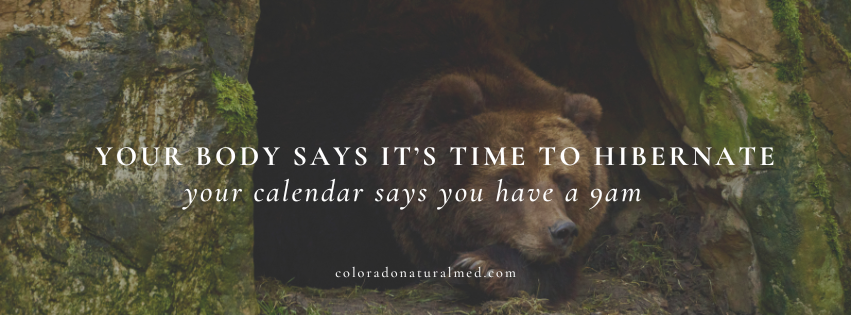
Shortening daylight sends a real, measurable signal to your body. The instinct to slow down this time of year isn’t laziness. It’s seasonal biology running into a modern schedule that was never designed around it.
Medically reviewed by Dr. Graves, ND, Colorado Natural Medicine & Acupuncture, Castle Rock, CO
This article is intended for general education and does not replace individualized medical evaluation. Talk with your healthcare provider about your specific symptoms and health history.
By early October, the days are noticeably shorter than they were a month ago, and something in you may already be responding to that, even if nothing else in your life has changed.
A pull toward more sleep. Less motivation for the things that felt easy in July. A craving for heavier, warmer food. A general sense of wanting to do less.
Most people either push through it or quietly assume something is wrong with them.
Neither is quite right.
Your body has always paid attention to the seasons. Modern life just gives it very little room to respond.
Your Body Is Still Reading the Days
Long before clocks, calendars, and electric lights, one of the body’s most reliable signals for what season it was came from how much light was available.
That signal still works.
A classic study exposed healthy volunteers to a shortened, winter-like photoperiod for several weeks and found that the duration of nighttime melatonin secretion measurably increased in response (Wehr, J Clin Endocrinol Metab, 1991).
Melatonin isn’t just a sleep hormone. Its timing is one of the ways the body translates environmental light into information about when to be awake, when to sleep, and how to organize daily biological rhythms.
In other words, your body can tell the nights are getting longer.
It responds to that information whether or not your calendar gives you permission to.
The Seasonal Shift You Feel Isn’t Imaginary
Humans don’t hibernate the way bears do. But that doesn’t mean we are biologically indifferent to the seasons.
Changes in daylight can influence circadian timing, sleep, mood, appetite, and energy. The shift is usually subtle. You may simply notice that getting up feels harder, evenings feel more appealing, or the high-output pace that felt natural in summer suddenly requires more effort.
That doesn’t necessarily mean you need to fight your way back to your July baseline.
It may mean your physiology is asking for a different rhythm.
The problem is that modern life doesn’t change with the light.
Your alarm still goes off at the same time. Work still starts at the same hour. School schedules don’t care that the sun is setting earlier. Dinner still needs to happen. The emails still arrive.
Your biology gets the seasonal signal.
Your calendar gets the final say.
When the Seasonal Signal Becomes Something More
For most people, the fall shift is mild. A little more tired. A little more drawn toward sleep and comfort. Manageable.
For some people, it is substantially stronger.
Research comparing people with seasonal affective disorder to healthy volunteers found that patients with seasonal affective disorder showed a significantly larger seasonal change in melatonin signaling, including longer nighttime secretion in winter compared with summer, a pattern that was not seen in the healthy comparison group (Wehr et al., 2001).
That’s an important distinction.
Feeling like you want to slow down in October isn’t automatically a disorder.
But if the seasonal shift brings persistent low mood, significant changes in sleep or appetite, loss of motivation, or symptoms that interfere with your ability to function, it deserves more attention than simply telling yourself to push through.
The season may be the trigger.
That doesn’t mean it has to be the whole explanation.
What This Looks Like in Practice
At Colorado Natural Medicine & Acupuncture in Castle Rock, supporting seasonal changes isn’t about forcing the body to behave exactly as it did in July.
It’s about figuring out whether the shift you’re experiencing is a normal seasonal adjustment or whether something else is making it harder for your body to adapt.
Depending on your symptoms and health history, that may include:
- Evaluating vitamin D and other nutrients affected by reduced sunlight exposure
- Looking at sleep quality and circadian habits
- Assessing whether persistent fatigue has another underlying contributor
- Identifying when symptoms warrant evaluation for seasonal affective disorder rather than simply being attributed to the time of year
If sleep is the piece that’s actually changed, that’s worth a real look, not just a guess about the season. Book an appointment with Dr. Graves to get to the bottom of it.
The goal isn’t to override your biology.
It’s to understand it well enough to work with it.
Maybe You Don’t Need to Fight the Slowdown
There is a difference between being depleted and being in a season that asks you to do things differently.
Sometimes the answer isn’t another strategy for squeezing the same amount of output from yourself.
It’s earlier nights.
A warmer dinner.
More recovery between demanding days.
A little less pressure to maintain the exact pace you kept when the sun was still out at 8:30.
None of that means giving up.
It means recognizing that your body doesn’t experience the year as a flat line.
The light changes.
Your physiology notices.
You can either spend the season fighting that signal or learn what it’s actually asking for.
Frequently Asked Questions
Is it normal to feel more tired when the days get shorter?
Yes. Changes in daylight can influence circadian rhythms and melatonin timing, which can contribute to normal seasonal changes in sleep, energy, appetite, and mood. A mild shift does not automatically indicate a health problem.
Why does shortening daylight affect melatonin?
Light is one of the primary environmental signals that regulates the body’s circadian system. Research has shown that exposure to shorter, winter-like photoperiods can lengthen the duration of nighttime melatonin secretion, giving the body information about seasonal changes in day length.
How is seasonal fatigue different from seasonal affective disorder?
Seasonal affective disorder is more than simply feeling tired or wanting to slow down in the fall. Symptoms are persistent and significant enough to interfere with daily functioning and can include substantial changes in mood, sleep, appetite, motivation, and energy. If the seasonal change is affecting your ability to function, it deserves an evaluation.
Can anything help with the transition into fall and winter?
Supporting consistent sleep, maintaining healthy light exposure, staying physically active, and paying attention to nutrition can all help support circadian and seasonal adjustment. Depending on your symptoms, acupuncture or individualized naturopathic care may also be appropriate.
When should seasonal tiredness be evaluated?
If fatigue, low mood, changes in sleep or appetite, or loss of motivation are persistent or significantly affecting your daily life, don’t automatically blame the season. An evaluation can help determine whether seasonal changes are the primary factor or whether something else is contributing.
We offer a free 15-minute phone consult for new patients. If this time of year consistently hits you harder than it should, that’s exactly the conversation we’re here to have.
Leave a Reply