
The Medicine Does the Heavy Lifting. My Job Is Everything Around It.
A clinical look at what actually happens during a guided medicine retreat, and why the container around the experience matters.
By Dr. Adam Graves, ND, LAc, Colorado Natural Medicine & Acupuncture
This fall, for the first time, I’m stepping into a leadership role for a retreat built specifically for men.
I’ve supported this work before. This time, I’m co-leading the retreat alongside Ben Mooney.
Rachel has spent years building the community and the experience around this work, and she’s talked a lot about why these retreats matter. I want to talk about what happens from my side of it, what my role actually is, why the experience is structured the way it is, and why the space around the medicine matters so much.
The Medicine Does the Heavy Lifting
Here’s the simplest way I can put it: I’m not the one doing the work.
The medicine is.
My job, and Ben’s, is everything around it.
A psilocybin experience can bring people into a very different state of awareness, sometimes opening up emotions, memories, patterns, or perspectives that are difficult to access in ordinary life. We don’t need to force that process or direct someone toward a particular outcome.
Our job is to create the conditions where a person can experience it safely.
That means helping people feel grounded. Helping them understand what’s happening. Helping them notice when they’re trying to fight or control the experience. And reminding them that they don’t have to figure everything out in the moment.
There’s also an important piece that comes afterward.
Part of this work is learning to recognize what it feels like when you’re operating from an old, familiar pattern versus when something has actually shifted. Most of us aren’t particularly practiced at noticing that distinction.
You can understand something intellectually for years and still keep doing the same thing.
Experiencing something differently is another matter.
Why Acupuncture Is Part of the Protocol
People sometimes ask why acupuncture is part of a retreat centered around plant medicine.
The answer is pretty straightforward.
We want people to arrive at the medicine experience feeling as calm, connected, and grounded as possible.
That’s why the sequence matters.
We begin with yoga, giving people a chance to move, breathe, and come out of the constant activity of everyday life.
Then we use acupuncture.
Then the medicine experience begins, with participants lying down and listening to a sound bath throughout the experience.
Each part serves a purpose. None of it is there just because it sounds nice.
Acupuncture, breathwork, movement, and sound are all ways of helping someone settle into the experience rather than spending the experience trying to control it.
Because that’s one of the hardest things about this kind of work.
Letting go.
The medicine is going to do what it’s going to do. Fighting the experience can make it more uncomfortable. Allowing it to unfold can make it easier to move through.
Our job isn’t to control the outcome.
It’s to help create enough safety that someone doesn’t feel like they have to.
What Support on The Retreat Looks Like
Someone who is there to remind you to breathe. To help you stay grounded. To get you water if you need it. To take a walk with you if that’s what would help. To remind you that you’re safe if something suddenly feels intense.
And if something emotional comes up, we’re there to help you stay with it rather than immediately push it away.
Sometimes that means saying very little.
Sometimes it means reminding someone that what they’re feeling will pass.
Sometimes it simply means being a calm person in the room when someone needs to know they’re not navigating the experience by themselves.
That’s really what holding space means to me.
We’re not there to tell someone what their experience should be.
We’re there so they don’t have to experience it alone.
Why a Men’s Retreat?
I’ll speak in generalizations here, because that’s genuinely what this is.
For a lot of men, asking for help is wrapped up in identity.
Be strong. Do it yourself. Figure it out. Handle it.
There can be a lot of ego tied up in admitting, “I’m stuck,” or “I don’t know how to get out of this pattern.”
But asking for help and being strong aren’t opposites.
I actually think being willing to admit that you need help can be an expression of strength.
That’s one reason I’m interested in creating a space specifically for men.
Not because men need to be treated as some completely different species.
But because there’s something powerful about being in a room with other men where nobody has to perform. Nobody has to have it figured out. Nobody has to be the guy who has everything under control.
You’re just there to do the work.
That’s how I think about it.
We’re there to do the work.
And part of that work is recognizing that we’re not actually meant to do everything alone.
I think of that as interdependence.
When you’re down and I’m up, I help.
When I’m down and you’re up, you help.
That’s not weakness.
That’s community.
And that’s a big part of healing.
What Plant Medicine Has Shown Me That My Medical Training Didn’t
My clinical training in naturopathic medicine and acupuncture is built around logic, systems, science, and safety.
That’s important. It’s how we learn to understand the body, evaluate what’s happening, and make thoughtful decisions about care.
But there’s a difference between understanding something and experiencing it.
Plant medicine has shown me a different side of healing, the emotional processing, the openness, the connection between mind and body, and the possibility of experiencing something rather than simply thinking about it.
Most people don’t come to this work because they want another person to explain their problems to them.
They want to feel different.
They want to experience something different.
They want to get unstuck from patterns they already understand intellectually but haven’t been able to change.
For me, that’s one of the most interesting parts of this work.
It takes something that can be very logical and intellectual, everything we know about health, behavior, patterns, and the brain, and gives someone the opportunity to experience it in a much more direct way.
That’s a very different kind of learning.
What It Actually Feels Like to Arrive
The clinical side of this work is important, but it’s not the whole experience.
You arrive at Half Moon Ranch and drive through the gates onto 70 acres of rolling hills, a creek bed, wildlife, horses, and open space.
You cross the bridge to the retreat house.
And then everything slows down.
There’s sage and incense. Essential oils. Green mandarin. There’s food being prepared by Cindy, who puts an incredible amount of care into everything she makes.
You meet the other participants.
You talk.
You share why you’re there and what brought you to this particular place.
And then, before you know it, you’re moving into the next part of the experience.
Yoga.
Acupuncture.
The ceremony.
The medicine.
The sound bath.
And then several hours where your ordinary frame of reference can shift completely.
That’s the part that’s difficult to explain if you haven’t experienced it.
Rachel once described these retreats to me as feeling like “going on an adventure, like flying to a foreign country I’ve never been to before.”
That’s not language I’d naturally use clinically.
But I understand what she means.
She’s describing what it feels like.
I’m describing what helps make that experience safe enough to have.
The Retreat Isn’t the End
One of the things I think is important to understand is that the retreat itself isn’t the finish line.
You don’t have a profound experience and then simply go back to exactly the same life and call the work done.
What happens afterward matters.
That’s why integration is part of the process.
Participants leave with tools and practices to continue working with what came up during the retreat, along with an invitation to stay connected through monthly integration calls and gatherings at Half Moon Ranch.
Because the goal isn’t to have one extraordinary day.
The goal is to take something from that day back into ordinary life.
Into your relationships.
Into the way you respond when you’re stressed.
Into the patterns you’ve been trying to change.
Into the way you understand yourself.
That’s where the real work begins.
If You’re the Guy Who Usually Handles Everything
I don’t expect this to be an easy thing to say yes to.
Most men aren’t going to wake up one morning and think, “I should probably go to a plant medicine retreat.”
There’s usually some circling first.
Some curiosity.
Some hesitation.
Maybe a recognition that something isn’t working the way it used to.
Maybe you’ve been carrying something for a long time.
Maybe you’re successful on paper and still feel stuck somewhere you can’t quite explain.
Maybe you’re tired of understanding the problem and want to experience something different.
If you’re the person other people lean on, the one who’s supposed to have it handled, this isn’t a referendum on whether you’re strong enough to need help.
You don’t have to arrive knowing exactly what you want to change.
You don’t have to have the right words.
You don’t have to know what the experience is going to bring.
You just have to be willing to show up and do the work.
We’ll take care of everything around it.
The medicine can do the heavy lifting.
And maybe that’s part of the lesson, too.
Sometimes strength isn’t carrying more.
Sometimes it’s being willing to put something down.
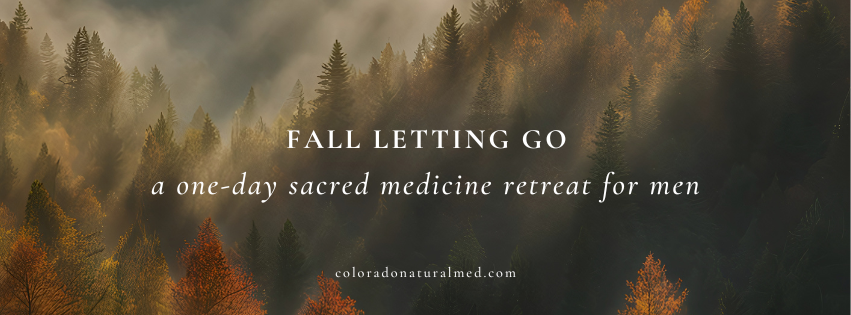
Fall Letting Go: A Sacred Medicine One-Day Men’s Retreat
Led by Dr. Adam Graves, ND, LAc and Ben Mooney
Half Moon Ranch
Castle Rock, Colorado
Space is intentionally limited.
Leave a Reply